Showing posts with label Studies/Reports. Show all posts

Saturday, June 8, 2013

Mommy or the Touchscreen? ABC News Puts "iBabies" to the Test

Here's a tough choice for a baby: Go to Mommy or go to a shiny, glowing touchscreen? An ABC News reporter put some babies to the test for a segment on ABC World News this week, positioning each baby across the room from both the baby's mom and an iPad or smartphone.

It turned out the choice wasn't so hard after all: The babies crawled straight to the mobile device every time, all but ignoring poor Mom. (See the full report and experiment below.)


The news segment, titled "iBaby," took a quick look at the phenomenon of small babies — "the diapered set," as reporter Juju Chang called them — being given smartphones and tablets to use.

It cited a new study by Northwestern University, out this week, that found that 37% of parents who have smartphones or tablets say they are likely to use these devices to keep their children occupied. The same study showed that 54% of parents are concerned that mobile devices have a mainly negative effect on their children's physical activity. (A similar percentage felt the same about TV, computers and video games, by the way.) And yet 55% of those surveyed said they are "not too" or "not at all" concerned about their children's media use in general.

The ABC report is short (under three minutes), so it doesn't delve too deeply into the topic or draw many conclusions. It also seems to showcase parents on one end of the spectrum only — the end where giving an infant or toddler a touchscreen is part of everyday life.

The report began by showing a 10-day-old baby — yes, that's 10 days old — propped up inches from an iPad, staring at the screen. The baby's mother is shown saying, "I guess I just didn't think it was going to hurt, so why not give it a try, and he seemed to like it."

The segment later cuts to a mommy-baby playgroup, where a mother of a 13-month-old had this to say: "I feel kind of guilty when he's sitting there with it, but at the same time I know that I'm going to get him to eat dinner if I give him the iPad."

The iPad Stroller Mount
A lot of babies are eating meals with iPads these days. A trip to most restaurants will verify this. You see it even in strollers, where small babies are handed smartphones and tablets to stare into while parents or nannies feed them. You can even attach iPads to strollers now with devices like iStroll Kid or the iPad Stroller Mount (for mealtime or just general "use" by a strolling baby).

I've said it before, but it's worth noting again: No baby ever sat down for a meal with an iPad prior to three years ago, because iPads didn't exist. So the "it gets him to eat dinner" argument doesn't sit well with some folks — including many incensed viewers who commented on the ABC News report online. Sure, it works, but it's unsettling to think that some parents today might feel out of other options at mealtime. Long before iPads were created — even before TV was around, if anyone can imagine that far back — babies somehow managed to eat their dinners.

So yes, it can be disturbing to see so many babies staring into touchscreens — in playgroups, in museums, in libraries, in a beautiful park on a lovely, sunny day. But in reality, their caregivers are in the minority (for now, at least). The new Northwestern study, titled "Parenting in the Age of Digital Technology: A National Survey," showed that, by and large, parents are still much more likely to use books, toys or other activities to keep their children occupied than to use touchscreen devices. They're also still using TV more than touchscreens to keep their kids busy.

The same holds true when it comes to calming a child who's upset: Parents are more likely to use activities, toys or books (and yes, TV) than a tablet or smartphone, the study found.

It might surprise some that the vast majority of parents surveyed for this study — 70% — said they do not think smartphones and tablets make parenting easier. Only 29% said that they do. And a mere 10% of those who own a mobile device said they would turn to it as an "educational tool" for their child.

And it's parents' own styles when it comes to media that drive their children's use of screens, the study found — i.e., it's not the children pushing for screen time that's driving how much they get. It is parents who create the types of media environments their kids grow up in, the study found. Parents "set the tone and create a 'family media ecology' that permeates through the generations," the study reports.

The ABC segment doesn't dig too deeply into the many findings of this new study. It concludes with some basic recommendations from experts: Use touchscreen devices as teaching tools rather than electronic babysitters; interact with your child when he or she uses these devices. But the new Northwestern study is worth a closer look. Its findings were illuminating, even intriguing, in this age of mobile media and "iBabies" who choose the lure of the touchscreen over Mom.

Friday, February 22, 2013

Preschoolers on "Media Diet" Show Improved Behavior: Study

It's no secret that preschoolers really like TV. And with more ways than ever now to access TV content — Elmo's just a tap away on Dad's new tablet — it's becoming more a part of preschoolers' daily lives all the time. In fact, it's estimated that preschool-aged children in the U.S. watch almost four and a half hours of TV each day at home and in daycare settings.

There are any number of studies out there about the negative effects of too much TV. (Not to mention this chilling report from New Zealand this week linking early TV watching to later criminal convictions.) But pediatrician Wendy Sue Swanson says the right kind of TV can improve children's lives. In the February 18 Huffington Post article "Preschoolers Can Learn Great Things From TV," Swanson discusses new research out this week that showed that a group of preschoolers who were put on a "media diet" — their parents paid special attention to the kinds of shows they were allowed to watch — exhibited better behavior after just six months.

The study, by Dimitri Christakis, pediatric researcher at Seattle Children's Hospital, was published online in the journal Pediatrics on February 18. It did not focus on how much TV the children watched; it was strictly about what they watched. With the encouragement and help of case managers, a group of children ages 3 to 5 in a "media diet" intervention program watched more "prosocial" content and less violent and inappropriate content than children in a control group.

"Prosocial programming," Swanson writes, "is that kind of TV show that promotes children acting in kind ways or shows children sharing. In prosocial shows, adults are portrayed as dependable and helpful."

The media diet worked: Scores for social competence and behavior improved significantly for the kids in the intervention group. They showed less aggressive and more prosocial behavior than those in the control group. At both the 6-month mark and the 12-month mark, they demonstrated more helpfulness, concern for others and empathy.

"It's a variation on the 'if you can't beat 'em, join 'em' idea," writes pediatrician Claire McCarthy in the Pediatrics article "Pediatricians and Television: It's Time to Rethink Our Messaging and Our Efforts" published online February 18. "If the screens are going to be on, let's concentrate on the content, and how we make it work for children."

Swanson offers tips for creating your own media diet with children at the end of her piece. For more advice about good TV programming for young children, check out "Must-See TV for Preschoolers and Kindergarteners" on Education.com. For even more on TV and young children, see this article on preschoolers and this one on kids under age 3 on PBS Parents. For info on TV viewing and children of all ages, see this fact sheet from the American Academy of Child and Adolescent Psychiatry (AACAP).

Saturday, February 9, 2013

Playing Digital Learning Games at Home Improves Early Math Skills: A WestEd Study

Can a digital Cat in the Hat help boost preschoolers' math skills? A new study from WestEd found that using a collection of online games and related at-home activities from PBS KIDS — including some based on "The Cat in the Hat" — increased preschoolers' math knowledge and skills, making them better prepared for kindergarten. The San Francisco-based nonprofit agency reported that a group of low-income preschoolers who used the PBS KIDS materials (called "transmedia suites") outscored a comparison group on the Test of Early Mathematics Ability (TEMA), a widely used standardized assessment.

But the study was as much about parents as it was about kids. In fact, it was all about parent-child interaction. The children's parents participated in weekly meetings to learn about the PBS KIDS games and related hands-on learning activities over an eight-week period last summer. They were encouraged to spend 30 minutes a day, four days a week, using the games and activities with their kids. In general, they played more than five games a week with their children, the study says.

One of the study's key aims was to see if parents' awareness and support of their children's mathematics learning at home would increase after the eight weeks. And guess what? It did. Parents reported that they felt more empowered to teach their children after the experience, and they became more aware of their kids' mathematical abilities. Parents working closely with their kids using educational games: a simple win-win. And more evidence supporting many-an-experts' view that kids learn best from digital media when their parents use it with them.

The content and games in this study were developed through the Ready to Learn Initiative, an early learning project of PBS Kids and the Corporation for Public Broadcasting (CPB), funded by the U.S. Department of Education. The DOE posted this article on the study on February 4. Find the study's executive summary here and the full report here.

Thursday, February 7, 2013

Child e-Book Reading on the Rise: A Scholastic Study

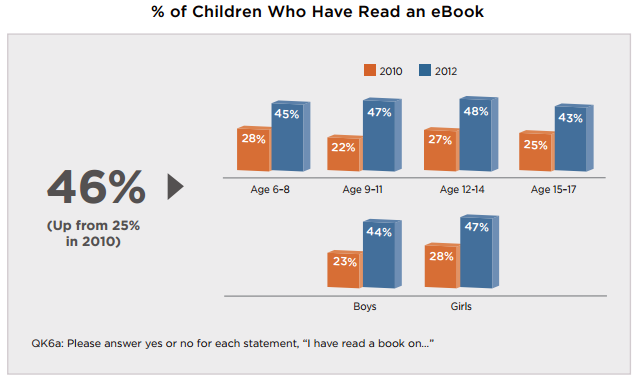
The number of kids who've read an e-book nearly doubled between 2010 and 2012, Scholastic's new "Kids & Family Reading Report" finds. Among over 1,000 kids ages 6-17 surveyed, 46% said they've read an e-book, up from 25% in 2010. Their parents' e-reading habits have increased as well: 41% said they've read an e-book, up from just 14% in 2010.

From Scholastic's "Kids & Family Reading Report"

Interestingly, when asked what books they like to read for fun, a full 80% of the kids said they read mostly print books (vs. e-books). "I like the feel of the book in my hand," a 13-year-old girl in Georgia told Scholastic. "Books in print you keep forever," said a 15-year-old Ohio girl.

Still, almost half of the parents surveyed (49%) said their child does not spend enough time reading for fun  a jump from 36% just two years ago. By contrast, 33% said their child spends "too much time" or "way too much time" playing video or computer games on any kind of electronic device; and 32% said the same about the time their child spends visiting social networking sites like Facebook and Twitter. See Scholastic's full report here.

2012 Was an Interesting Year

It's February 2013, and this marks the launch of "The Digital Child," a hub of news, resources and information on children and digital media. Before 2012 gets too far behind us, here's a round-up of some of the big news, studies and other developments of the year.

Kids' Tablets Explosion

If it seemed like there was a new made-for-kids tablet out each time you turned around, it's probably because there was. It was the year of the kid tablet  from the Toys "R" Us Tabeo, with its Hello Kitty and Angry Birds accessory cases, to the Fuhu Nabi Jr. (shown) for the preschool and kindergarten set, equipped with a "baby monitor" video camera for parents. Kid tablets tend to be plastic, easy-to-grip for tiny hands and rubber-edged for extra durability. They come with an array of parental controls but a price tag not that much less than some adult versions (many are in the $150-$200 range). 

Children's Technology Review offered this in-depth report on the market in December, analyzing and reviewing tons  and tons  of kid tablets. ConsumerReports.org also lab-tested and kid-tested five popular 7-inch Android kid tablets in December. And see these reviews from Forbes. Expect much more news and reviews this year as the tablets-for-tots market explodes.

Study: Apple's App Store Heavily Targets Young Children

Speaking of exploding... over 80% of the top-selling paid educational apps in Apple's iTunes App Store now target children, a January study by the Joan Ganz Cooney Center at Sesame Workshop found. Of these apps, a whopping 72% target preschoolers. And it's a fast-growing market. An addendum to this study, from the summer, zoomed in on Apple's App Store's games category (which has an entire section devoted to kids, unlike its education category). It found that a full 56% of games apps target the toddler/preschooler set  by far the most popular age group. And almost a third of games apps (32%) make "some sort of educational claim," stating a learning objective. All of the apps making such claims target preschoolers and toddlers. 

FTC Warning: Privacy Woes Over Kids' Apps

With so much "app-tivity" geared toward the very young, can we soon expect an "app-lash"? In light of some looming privacy concerns, it's very possible. In December, the Federal Trade Commission outlined many troubling concerns over privacy and children's apps in its report "Mobile Apps for Kids: Disclosures Still Not Making the Grade." It was the FTC's second recent survey of the privacy disclosures and practices of children's apps (their first report was released in February 2012). Both surveys showed that app developers and stores are not providing parents information about the data being collected on their kids, who they're sharing it with and how it is being used. Parents, take note. Find the full FTC report here.

New Ratings: Got Learning Potential?

In April, Common Sense Media beta-launched a new rating system for kids' digital media to help parents and teachers find the more worthy products. The nonprofit organization rates websites, apps and video games as "Best for Learning," "Good for Learning," "Fair for Learning," or "Not for Learning." It is easy to search products by media type, title, age and the ratings themselves.

Panel: "Baby Brains and Video Games"

An expert panel held by New America NYC shed some light on a range of issues surrounding little ones and digital media last March. They discussed the latest research and outlined common concerns adults have about young minds and digital devices. One strong message was that content does matter. As panelist Rosemarie Truglio, senior VP of education and research for Sesame Workshop, put it, "Just because something is interactive does not necessarily make it educational." A lively Q&A followed the panel discussion. 

Some 2012 Articles Worth Reading:

"Educational Apps Alone Won't Teach Your Kid To Read"Slate, December 13, 2012
Adult-child interaction is still the most important factor in teaching literacy, write Lisa Guernsey and Michael Levine. They are two authors of the new report "Pioneering Literacy in the Digital Wild West", which analyzed apps and e-books that promise to help kids learn to read. The report found that the most popular ones tend to focus only on very basic literacy skills without addressing higher-level skills such as vocabulary development and comprehension. "At its best, the technology complements the work of trained teachers and parents," they write. "It doesn’t replace it." Guernsey is the director of the Education Initiative at the New America Foundation (and was a panelist on the above-mentioned "Baby Brains" panel). Levine is executive director of the Joan Ganz Cooney Center at Sesame Workshop.

"Is Technology Sapping Children's Creativity?", The Washington Post, September 13, 2012
Early childhood development expert Nancy Carlsson-Paige reminds adults exactly how young children learn: "through direct play and hands-on experiences with people, with materials, and in nature," she writes. She discusses the importance of playing in the three-dimensional world and using good ol' fashioned open-ended materials like blocks, play-dough, sand and water. She also asks if when we quiet our kids with little screens, "are they missing out on the chance to feel, to argue, to sit in silence, to listen, to be?" (P.S.: Carlsson-Paige is also the mother of actor Matt Damon  and a former neighbor of the author of this blog, from the blogger's own early childhood.)

"Sunday Dialogue: How Children Play", The New York Times, June 30, 2012
Another interesting discussion about children's learning, this one from The New York Times' "Letters" section. In a letter responding to an earlier article, "Wasting Time Is New Divide in Digital Era", about how children and families in different socioeconomic strata use technology, Sarah Chumsky, a children’s media researcher, outlines the benefits of digital media for children. Readers respond, rather passionately. One challenge from a Waldorf School teacher, for example: "Watch your children while they are engaged with media of any kind. Look at their faces and their limbs. Then watch them while you are reading their favorite book or playing a game, or while they are on a swing. Then decide for yourself what is most benefiting your child’s deepest developmental needs."

"What Happens When Toddlers Zone Out With an iPad?", The Wall Street Journal, May 22, 2012
"In many ways, the average toddler using an iPad is a guinea pig," writes Ben Worthen — since scientific studies on the effects of such devices on toddlers' development can take three to five years, and iPads are not even yet three years old. Worthen discusses what pediatric neuroscientists and researchers have to say on the subject. He also documents what happened when his own toddler son started using an iPad (which he doesn't let him use anymore).

"Can Your Preschooler Learn Anything From an iPad App?"Slate, May 2, 2012
Another piece by Lisa Guernsey, veteran reporter and director of the Education Initiative at the New America Foundation  this one adapted from her March 2012 book, Screen Time: How Electronic Media — From Baby Videos to Educational Software — Affects Your Young Child. She discusses, among other things, the importance of apps and games that allow kids "open-ended" exploration and discovery, and the woeful lack of such products on the market today.